MATERIALS
Constituted Material Behavior
What persists, carries, insulates, conducts, preserves, reflects, or decays?
An element supplies properties before it acquires instructions.
A material is already something more.
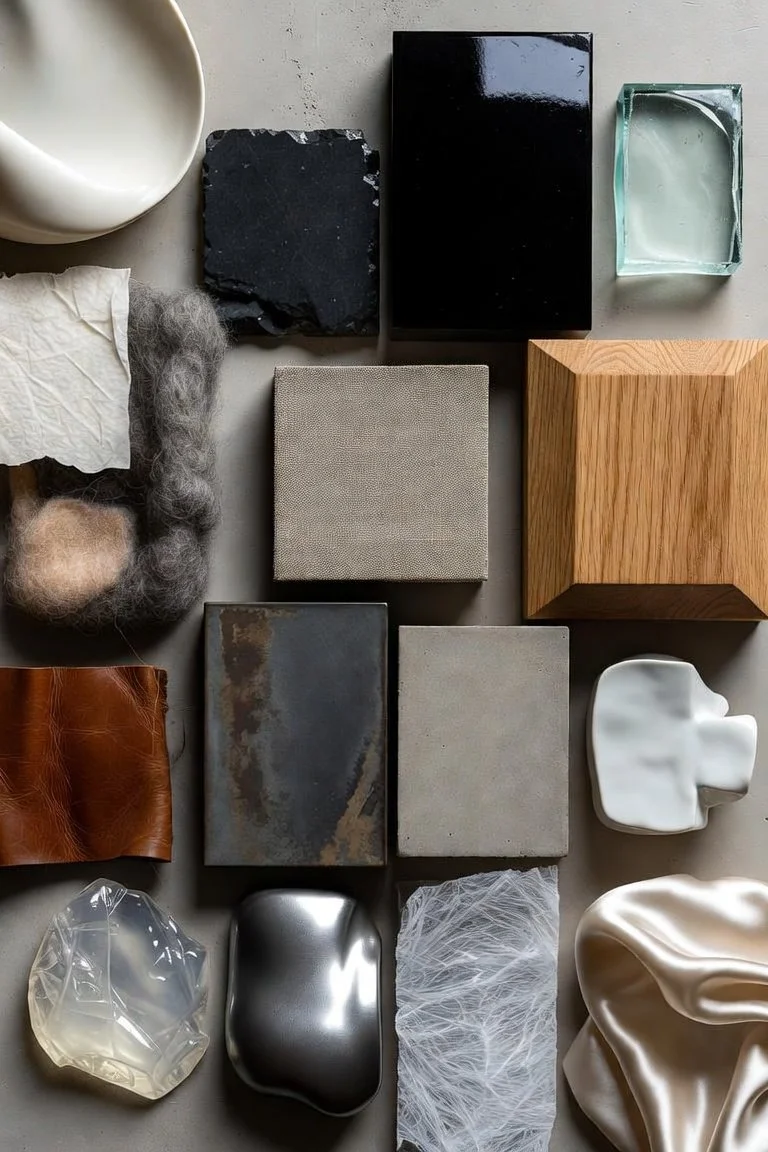
Porcelain is not an element. Neither are glass, steel, bronze, concrete, vellum, leather, paper, or linen. Each is a constituted material state produced through composition, structure, processing, or fabrication.
The Material Layer therefore begins where elemental capability becomes organized physical behavior.
Porcelain may insulate, resist chemical attack, retain a surface, fracture under particular loads, and survive conditions that destroy less stable materials.
Wool may insulate, absorb moisture, deform, recover, felt, compress, and decay.
Bronze may carry load, conduct heat, oxidize, wear, accept detail, and preserve form across extraordinary periods of time.
Paper may fold, receive inscription, absorb moisture, tear, burn, discolor, and preserve information far longer than its apparent fragility suggests.
These behaviors are not assigned by MICRO.
They belong to the material.
MICRO reads them as constraints and capabilities upon execution.
Material Identity
A material cannot be adequately specified by name alone.
Steel does not identify a single material state.
Neither does glass, ceramic, concrete, leather, paper, or resin.
Material identity therefore requires a sufficiently defined profile capable of distinguishing materially consequential variation.
This is where I would introduce the BASIS development specification. Something like:
MATERIAL ID
Canonical designation and material family.
CONSTITUTION
Elements, compounds, fibers, phases, constituents, or other components from which the material is formed.
FORMATION
The processes by which those constituents acquired their present material state: firing, alloying, cooling, curing, weaving, tanning, casting, pressing, annealing, etc.
STRUCTURE
Grain, weave, porosity, crystallinity, layering, fiber orientation, phase distribution, surface morphology, and other consequential organization.
MECHANICAL BEHAVIOR
Hardness, stiffness, elasticity, ductility, brittleness, tensile/compressive behavior, fatigue, fracture, wear.
THERMAL BEHAVIOR
Conductivity, expansion, thermal capacity, operating range, transition points, thermal-shock response.
ELECTRICAL / MAGNETIC BEHAVIOR
Conductivity, resistivity, dielectric behavior, magnetic response where relevant.
ENVIRONMENTAL BEHAVIOR
Oxidation, corrosion, moisture response, UV stability, chemical resistance, biological decay, weathering.
OPTICAL / SENSORY BEHAVIOR
Opacity, translucency, reflectance, texture, acoustic response, tactile character where constitutionally relevant.
TEMPORAL BEHAVIOR
How the material ages, creeps, fatigues, patinates, embrittles, decays, or otherwise changes through time.
FAILURE MODES
How material integrity is characteristically lost.
PROVENANCE
Source, grade/specification, formation history, and any prior state necessary to interpret the present material correctly.
That becomes the BASIS Material Specification.